
Irish Examiner Article
By Kevin Markham – Irish Golf Course Photographer and Golf Writer
https://www.irishexaminer.com/sport/golf/arid-41892142.html
The 20 best risk/reward holes in Ireland
The 13th Hole, The Valley, making the News with the “Most outrageous hole”
Ask anyone about risk/reward holes and, inevitably, a driveable par-4 gets mentioned. The 267-yard 13th at Lahinch is an obvious example. The question I find myself asking is, how big is the risk/reward when compared to playing the hole sensibly. If you go for the green or try to cut the dogleg, and fail, how severe is the punishment? And what element of danger have you removed vs going the obvious route? Have you made a difficult green more accessible, have you taken water or deep bunkers out of play, or is it simply that you’ve reached the green and you’re putting for an eagle. To that end, Lahinch’s famed 13th doesn’t make this list – but the 6th does.
But it isn’t all about short par-4s – far from it – and this list contains par-5s, possibly Ireland’s toughest par-4, and a solitary par-3. Some names are instantly recognisable, while a few may be less familiar. Interestingly, four of the entries are the 18th hole.
Portsalon 2nd
Par-4, 389 metres, Index 3
This is not dissimilar to Old Head’s 12th – see below – where the daunting challenge is how much of the dogleg you’re prepared to take on. What is so imposing is that you can see everything from the high tee, with the beach and river on full display, pushing hard into the corner of the right-to-left dogleg below. The reward for cutting across the beach and river is to shorten the approach, which is a huge bonus because the river also cuts across in front of the green. Find yourself too far back and it’s a par-5 in all but name; take on the risk and the approach can yield a rare birdie. This is also one of Ireland’s most beautiful holes.
Ballybunion’s par-5 16th has a similar feel to it, where you can take on more of the dune, thereby cutting across the dogleg and leaving a far shorter uphill approach.
Monkstown 4th
Par-4, 229 metres, Index 18 One of the most clearcut risk/reward short par-4s you’ll ever encounter because, unlike the longer 6th at Cork, a lot of golfers will fancy giving this 229-metre hole a lash. The hole rises gently uphill, hiding the green and flag… and much of the three bunkers which front the green. The green itself is benched into a hillside, and any shot that strays to the right will bound down the slopes and into purgatory – aka impenetrable trees and undergrowth. Come up short and the bunkers will snaffle you up. It is the easiest of par-4s when played as a two-shotter, but most of us will fancy taking it on, crossing our fingers that one lucky bounce will see the ball on the green.
Mount Wolseley 4th Par-4, 332 yards, Index 11
Mount Wolseley is not alone in having a deliciously short par-4 that bends hard-right around water, with the green so temptingly on show between the trees. You’ll find similar holes on Dromoland Castle’s 9th, Carlow’s 10th, Esker Hills’ 10th, and Rathsallagh’s 8th. Of these holes, Mount Wolseley offers the greatest risk/reward, for it is approximately 260 yards (white tees) or 240 yards (forward tees) of carry, with water all the way. Oh, how the over ambitious must salivate at the prospect of reaching the green with one mighty blow, only then to ask sheepishly where the drop zone is to be found.
Ballyneety 5th
Par-4, 393m, Index 2
Home to the Junior Ryder Cup, in 2027, Ballyneety is thriving. There are thrilling holes here, and the 5th is one. The hole disappears over a ridge, the fairway dropping sharply to a green far below. It offers both a safe and a risky option. The safe route is to hit no more than a 200-metre drive to leave you at the top of the hill. It should take the out-of-bounds along the right out of play, but it does leave you with another 200 metres to go, to a green protected by four bunkers. The riskier choice is to go all-in from the tee and try to reach the bottom of the hill, leaving an approach shot of 100-120 metres. The risk, however, is that if you fail your ball will be stranded on a strong downhill slope – not maintained as fairway – which will leave a very tricky stance for your next shot, with trees left and right, as well as those bunkers. It is early in the round, so how confident do you feel?
Royal Portrush 5th Par-4, 375 yards, Index 15 During the recent Open Championships, professionals drove the green on the famous ‘White Rocks’ hole. For us mortals that is asking too much, but there are still big decisions to be made from the tee, and big rewards to be gleaned. The sharp left-to-right dogleg is all on show from the high tee and you choose how much of the dogleg you want to take on. It is not an easy approach from distance because the green is almost 50 yards long, has considerable swing and drops sharply and quickly off the back, down towards the beach. (It’s out of bounds back there.) Being closer to the green definitely yields rewards but, if you come up short, the rough along the right side of the fairway will steal your ball in a heartbeat. To clear the corner of the dogleg and find fairway requires some 240 yards of carry.
Lahinch 6th Par-4, 412 yards, Index 2
A brilliant but lethal dogleg, curving left as the fairway rises above you, before disappearing into the dunes and heading out to sea. It is an imposing tee shot, whatever length you hit your drive, but there is a sneaky, rough-strewn hollow waiting in the middle of that hidden fairway, at about 250/260 yards. The thing is, you want to get as close to that hollow as you possibly can, otherwise the heavily-shaped and well-defended green below is hidden from you. Trust me, that is an incredibly challenging shot if you’re unsighted, plus you don’t get the joy of watching your ball fall to the green with the beach and ocean backdrop. This is one risk definitely worth taking, although the punishment of finding your ball in that hollow is severe, as it also includes a bunker!
Carne 8th (Wild Atlantic Dunes) Par-5, 515 yards, Index 4 For a course with numerous risk/reward holes, the dogleg par-5 8th is the stuff of legend. The hole slides through a deep, rolling dune valley to start. A good drive presents two options and a strategic conundrum. You can choose a line straight for the green, but it is a totally blind shot as you hit up and over an enormous dune to your right, with rough and bunkers awaiting on the far side. The reward is an easy pitch to a slippery green. Or, you take the safer lay-up option, by hitting a high-lofted club straight ahead, into the devil’s elbow, which then whips hard right. This route leaves a longer approach to a green ever so slightly above you. It is one of Ireland’s great par-5s, made all the more special by the choices you get to make.
Corballis 11th Par-4, 230 metres, Index 18
For a small, municipal links, Corballis is alive with fiendish risk/reward holes. Short par-4s abound and holes 2, 5 and 7 all embody that risk factor but the dogleg 11th takes the top prize. It is a sharp left-to-right dogleg with a pole high on the dune showing a direct line to the green. It’s as if they are inviting you to go for it – but that way madness lies. Land short and you’re in a dense tangle of dunes above the green, where your ball may never be found. You can’t go long or left, either, as there are sheer drops which will spirit your ball away. The entire area around the green is chaos but, at 230m, it feels like it deserves your best attempt, especially as playing the sensible route can still leave a semi-blind shot in. Index 18 it is not.
Old Head 12th Par-5, 537 yards, Index 3
The iron will to take on the cliff-tops of this magnificent hole says an awful lot about how you play golf. There’s little bail-out here – it’s to the right as the hole doglegs left, above the cliffs – but the risk of taking on more and more of the cliffs rewards you with a shorter and shorter approach. The green also sits next to those cliffs, so it’s not only the tee shot that falls into the risk/reward category. That iron will is required until you reach the putting surface.
Druids Glen 13th Par-4, 463 yards, Index 1
This is one of Ireland’s toughest holes, with water threatening both the first and second shots, and a fairway that wraps around a cliff-face as the hole bends left-to-right. Be in no doubt, this is a triple bogey waiting to happen, with so many threatening elements. Big hitters can take a huge risk to make this monster more manageable. Cut the corner, around that cliff, and find the hidden patch of fairway beyond the stream but short of the lake which separates you from the green. Do that and you may have no more than an 8-iron to see you home. If you play the safe route, playing for the fairway you can see from the high tee, you can be left with well over 200 yards to go… and you may find yourself forced to lay up in the same spot as the big hitter cutting the corner.
Enniscrone 13th Par-4, 338 yards, Index 13
One of the key elements of this brilliant par-4, which spirals down into a hollow in the dunes, is the level of risk you take on from the tee. There’s safe (5 iron), adventurous (5 wood) and reckless (driver). You can’t see the green from the high, high tee, but a hint of fairway is visible as it descends over two steep steps and swings around to the right. Missing the fairway is a severe penalty as these dunes swallow golf balls for good, but with good conditions and embracing your reckless spirit, you really could reach that hidden green. Chances are, however, you’ll never see your ball again. To be honest, the safe route – over a white stone – is just as rewarding and even more fun.
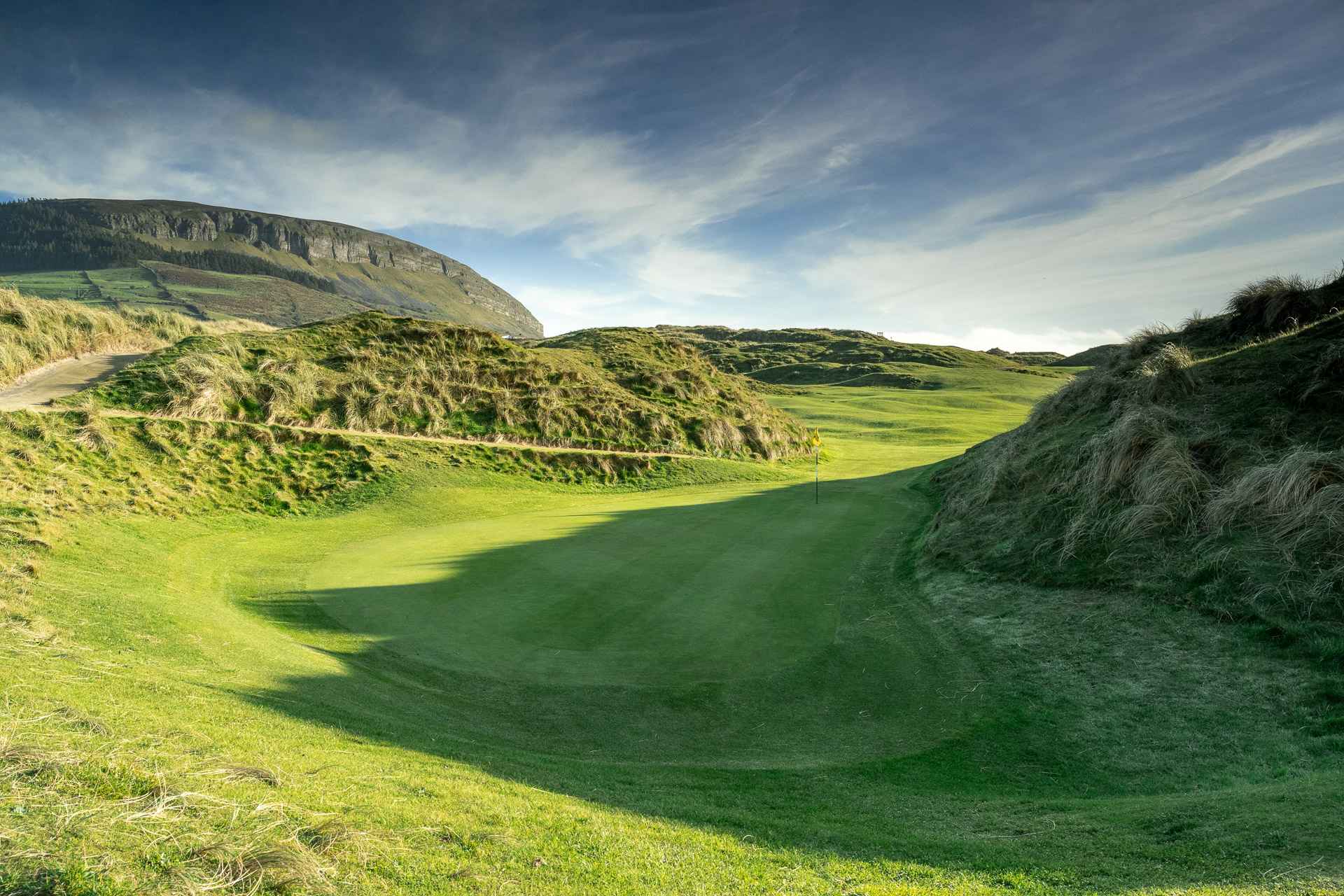
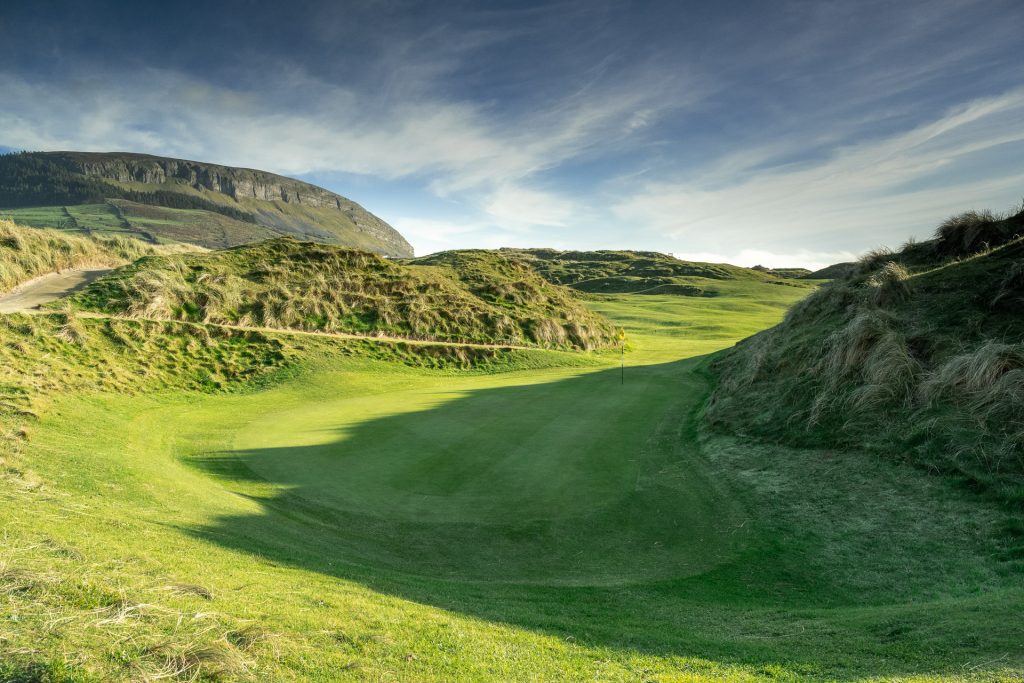
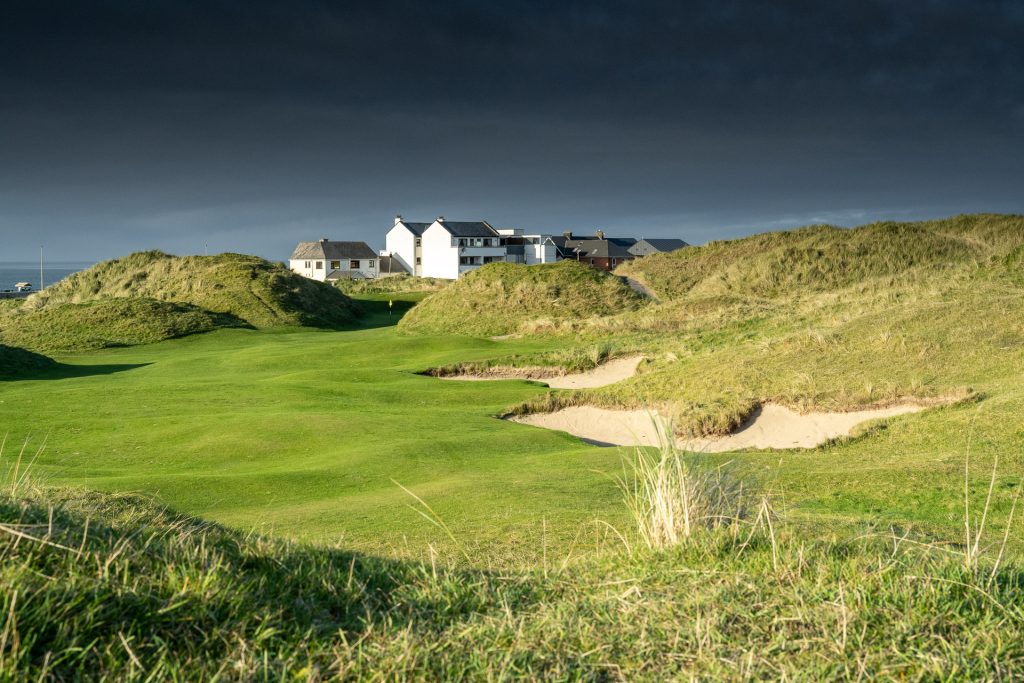
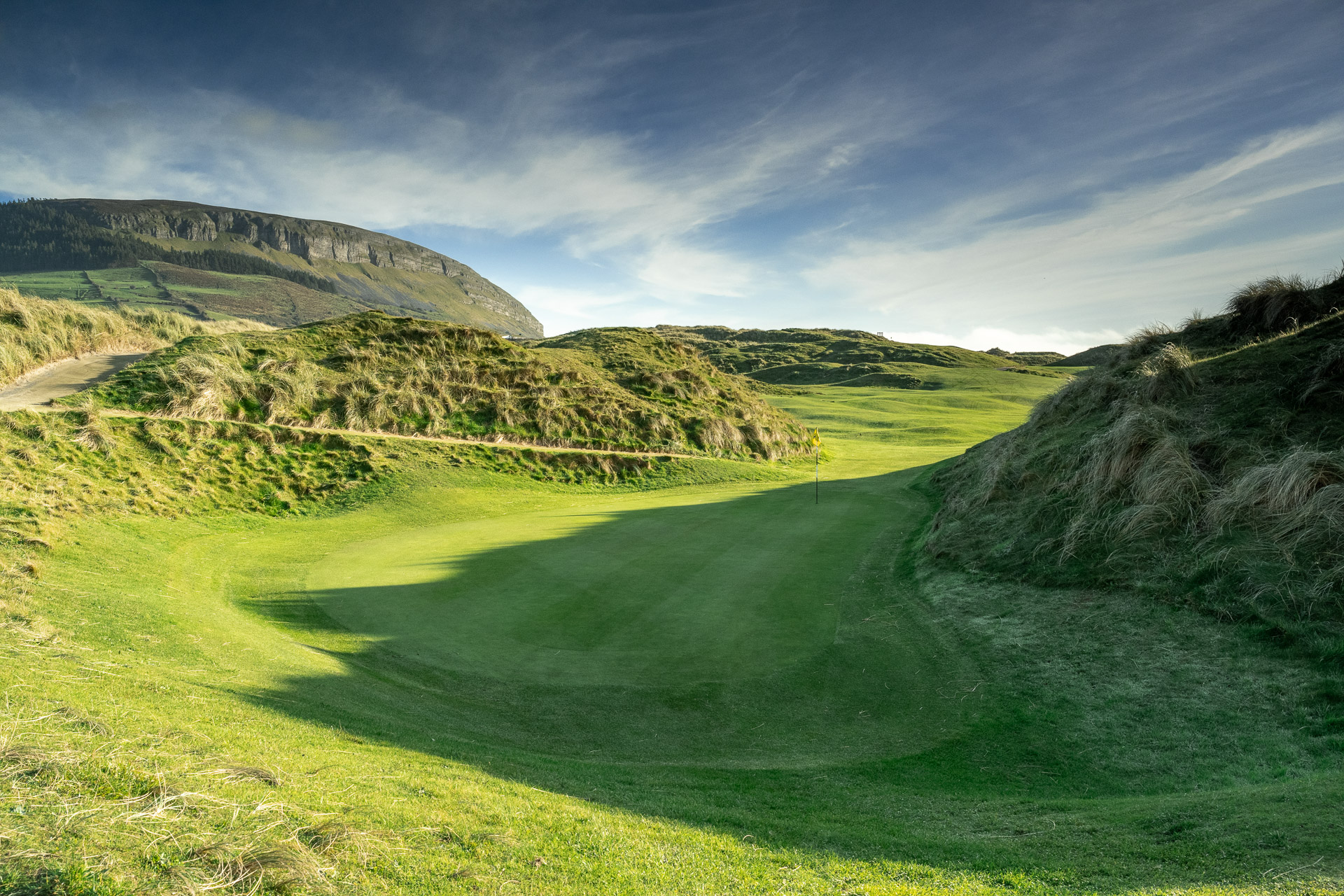
Strandhill 13th Par-4, 346 yards, Index 9 Winner of the title ‘Ireland’s most outrageous hole’, this short par-4 drops from the tee, into the dunes before whipping right and out of sight. Step up onto the viewing platform, on the tee box, and you get a good idea of what awaits. It can be as little as a 5-iron down onto the fairway you see below, or you can take the bravest of lines, over the dunes and drive straight at a green you can’t see. The risk from the two bunkers down in the hollow, never mind the rough, is something you may live to regret, but the reward for finding fairway cannot be overstated. The 13th boasts Ireland’s smallest green, tucked into a bowl behind two sentry dunes. Take the 5-iron route and you are left with a lengthy, daunting approach; but succeed with your driver and it’s a flick of a wedge or a bump-and-run shot through the narrow gap. It’s such a delicious choice, where the wind may help seal your decision.
Slieve Russell 13th
Par-5, 494 yards, Index 14
A par-5 that curls ever left around Lough Rud, challenging your bravery on every shot it takes you to reach the green – which is perched perilously close to the water. You can choose how much of the lake to take on from the tee, with a ‘safe’ route offering itself up the right-hand side, but many will take on the water and use the famous ‘SR’ logo as the tiger-line. If you play safe, then this is a three-shotter all the way. If you go all in, then you can double-down on the risk and go for a green that will require another carry over water, as a sliver of Lough Rud barges across the front left of the green. It’s very high on risk but the reward of an eagle putt is something special. Two mighty blows required. Concra Wood’s par-5 13th is a similar hole, but curving in the opposite direction.
Esker Hills 14th Par-4, 337 yards, Index 10
Many would pick the 280-yard par-4 10th as the big risk/reward at Shane lowry’s home course, while others might pick the 1st, which has similarities with Ballybunion’s 16th, but the 14th also barges its way into this conversation because of the challenge of the green. The hole doglegs from right-to-left, the fairway snaking out of sight through a deep valley in the eskers, leading to a tiered green, high above you. The risk of going for a big drive is that your tee shot gets caught on one of the valley sides, leaving the most awkward of stances; but the reward is that the elusive green is within range of a steeply lofted club, which makes finding the putting surface that much easier.
Royal County Down 16th Par-4, 318 yards, Index 14 The closing holes at RCD don’t get the respect they deserve. The short 16th is a perfect example, as it offers a brilliant opportunity of a birdie – or better – late in the round. The tee shows off the entire challenge of the hole – the five bunkers, the gently angled fairway and the hollow of rough mirroring the fairway, along the right side. You can see the route to the green perfectly – a fade is the shape you need – but the risks from RCD’s fearsome bunkers and the slopes slipping down into the hollow are high. The greens here are fast, so approaching from the wrong angle, or out of long grass or sand is a recipe for disaster, with little fall-offs sweeping your ball away. A simple par is there for the taking but on a course like this, you’ll want to smash your longest drive.
Royal Portrush 16th Par-3, 202 yards, Index 4 The only par-3 on this list and all because Calamity’s green sits high on a precipice and across a chasm. Short and right of the green is the route to despair, the rough-strewn dune almost sheer. Here, stances are better suited to climbing Mount Everest than playing golf.
Much of the green offers sucker pin positions but when you play here it is such a thrill that you’ll want your chance of glory. The carry of 186 yards to the front right edge makes it feasible, but you still need the confidence to make the perfect swing. Get it right, and a birdie putt on one of the world’s most feared par-3s beckons. Get it wrong and you’ll pay a steep price.
The safe route is to play for a bowl-shaped dip, near the front left of the green, well away from the trauma of the precipice. The dip is known as ‘Bobby Locke’s Hollow’ after the four-time Champion Golfer, who laid up here during every round of the 1951 Open Championship.
Dromoland Castle 18th Par-5, 528 yards, Index 7
There are several par-5s where there is considerable risk in how much of a lake you attempt to cross in order to shorten your route to the green. Dromoland Castle is but one, while Concra Wood’s 434m 15th, Slieve Russell’s 13th (see above) and all four of Palmerstown Estate’s par-5s are others. Dromoland’s 18th, however, deserves its inclusion for the beauty of the hole, the magnificent castle, and the intimidating and towering Monterey Cypress in the middle of the fairway. And let’s not forget the lake that now hugs the fairway all the way to the green.
The generous fairway is the obvious target but the reward for cutting across the lake – some 240/250 yards – to a far narrower neck of fairway may not be that you can get home in two, but it makes it infinitely easier to navigate around the Monterey Cypress, reduce the threat of the lake and position yourself for an easy and shorter approach to the green. It’s also worth pointing out that Dromoland Castle has four other excellent risk/reward holes: the short par-4s on 9, 10 and 15 – the 266y 15th is a peach – and the par-5 11th which almost mirrors the 18th.
Fota Island 18th (Deerpark) Par-5, 479 yards Index 18 A sneaky-tight fairway, squeezed by mature trees, is a daunting sight from the tee, especially with the green out of sight, in front of the clubhouse below. The length, however, will be too tempting for some on this straight 479-yard (White tees) hole. You don’t even need an enormous drive to bring the green into view – say 250/260 yards – but it’s all about being straight and then being willing to go for a green surrounded on three sides by water… which is made all the more intimidating by being below you. The better your drive, the more willing you’ll be to have a go. It is Index 18, so pars come easy… even if you have to take a drop after finding water, and then get up and down for par. But very much a birdie – or better – opportunity.
St Helen’s Bay 18th Par-4, 258 yards, Index 17
The perfect length short par-4, that so many will believe they can reach – with their very best drive, the wind behind and the golfing goods smiling down. Curving gently left, on the bluff above the beach and sea, the hole – named Pirate’s Cove – has a small green, with a bunker behind, and a fairway palm tree to add doubt. Pull it left and you are down the banks and out-of-bounds. If you go long, that’s also out-of-bounds, with the clubhouse right behind. It is a major risk to finish your round, especially with the fairway no more than 18 yards wide, but eagle putts are there for the taking… and there have been holes-in-one on it, too!
The Golf Course at Adare Manor 18th Par-5, 525 yards, Index 2 With the Ryder Cup rolling into town next year, it is only fair to finish this list with Adare’s par-5 18th, a daunting hole that clings claustrophobically to the River Maigue, from tee to green. Off the tee, the fairway streaks straight ahead, the river on your left and the green on the other side. The initial risk/reward element tempts you to hug the water’s edge as the true risk stems from there. On your second shot, do you continue the safer path, straight ahead, or do you attempt to cross the river, seeking out the apron of fairway in front of the green? It could involve a 180-200+ yard carry. If you find that piece of fairway the big green is at your mercy, but fail and you get wet. It is high risk, but even for those who continue along the right-hand side, there is a challenging third shot to cross the wide river and avoid the vast run-offs that Adare’s greens are renowned for. Everything will be dictated by your tee shot and how close you’re prepared to get to the river’s edge. Expect some glory and despair during the Ryder Cup.


 Splash