
by Bruce Selcraig | October 23, 2026
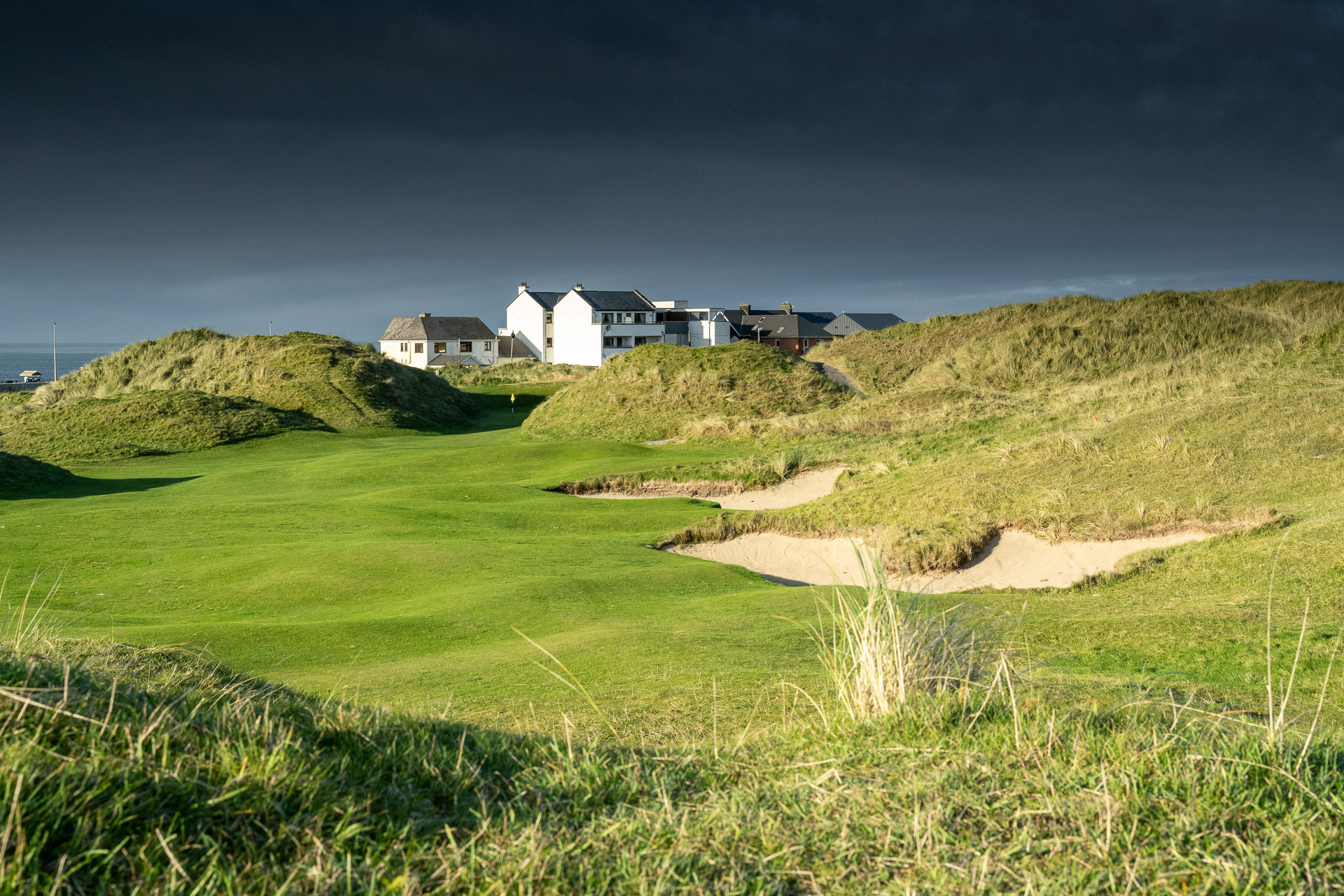
If there was a “bypassed Hall of Fame” for Irish golf, surely this idiosyncratic and endlessly fun course just six miles west of Sligo town yet very much in the shadow of Rosses Point would be a founding member.
Thirty years ago, before needed enhancements by architect Ally McIntosh and course manager Jason Kelly that revealed more natural beauty around tee boxes and greens, the esteemed golf travel author, Jim Finegan, a true scholar whose comprehensive books on Scotland, Ireland, England and Wales are cherished, somehow managed to survey all of County Sligo golf and ignored Strandhill. In 2006, to make amends, Finegan wrote in his mammoth coffee table book, Where Golf Is Great, that par-69 Strandhill boasted “stunning sea-and-hill vistas and dramatic elevation changes” with three “dull” holes (9, 10, 11) and two others (7, 13) that he deemed among “the finest par 4s in northwest Ireland.” Fair enough.
By 2007, the superb British-Canadian duo of Richard Phinney and Scott Whitley, in their updated Links of Heaven, waxed rhapsodic about Strandhill holes that were “incomparable…thrilling…picturesque…charming…and outlandish.” Finally, Irish golf authority Kevin Markham, in 2015, wrote in Hooked, “If you come this way to play Sligo or Enniscrone, do not pass Strandhill by. It is every bit as good, if only in a different way.”

And therein lies the rub. The American tour buses quite properly flock to Enniscrone and Rosses Point (Sligo), paying over $300 and $400 respectively, and those in charge wrongly decide that Strandhill, at roughly 6200 yards from the tips and about $260 (for 2027) in peak summer, probably isn’t quite ready for prime time. Their silly loss.
It’s perplexing, admits Strandhill’s director of golf, Xavier Medas, a charming Spaniard-Frenchman who joined my son and I for four holes on the front side. “Clearly, there are some visitors to Ireland who judge courses by the price, and they just assume we aren’t at a certain level.”
Understandably, the membership is not that bothered. They are a friendly welcoming lot – famous for their frigid winter tournaments that draw hundreds — not overly taken with crested coats and ceremony, lots of avid women hackers, perfectly happy with quirky unique holes like the par five No. 5, where you start with an invigorating elevated tee shot that has you thinking you’ll send the ball two furlongs. But you’ll need a high draw and you must clear a gnarly row of unforgiving dunes. Having navigated the dogleg left, you’re then confronted with a mogul-filled potato chip fairway, where your lie depends on luck and you’ve not even contemplated a strangely, somewhat sunken saucer-like green.
You’ve never seen a hole like this back in the States, nor will you see another quite like it in Ireland. And this is why you made the trip.
Bruce Selcraig is a former staff writer with Sports Illustrated and U.S. Senate investigator who has made 30 golf trips to Ireland and has yet to break 80. selcraig@swbell.net



 Splash